Pricing
How to Price Pump, Filter and Equipment Repairs on Your Pool Route
How to price pool equipment repairs from your cost per billable hour and your parts, what licenses cover in Florida, California and Arizona, and how to sell repairs to your route.
 PoolRoute7 min read
In this article
Price pool equipment repairs from your cost per billable hour plus the parts, with a margin on both, and check your state's license rule before you touch a pump, heater or valve. In our round example, a repair hour costs you $52.00 and is priced at about $70, and a pump motor replacement with a $350 part comes to about $540. Every dollar figure is an example built from our pricing guide. We found no government or trade association page that publishes what pool repairs should cost, so this guide gives you the method, not a price list.
Weekly service pays the bills. Repairs add to it, on stops you already make. You are at every pool every week, so you see the failing pump, the high filter pressure and the leaking valve before anyone else.
Do you need a license to repair pool equipment?
It depends on the state, and the line is usually between cleaning and equipment work. Three examples, read on the day we wrote this:
Florida. The statute on contractor licensing says that a license is not required for the cleaning of the pool or spa in a way that does not affect the structural integrity of the pool or its equipment, and that water treatment that does not require such equipment does not require a license. The same section defines the swimming pool/spa servicing contractor, whose work includes repairing or replacing existing equipment. So weekly cleaning and chemicals do not need the state contractor license, and a pump or heater job does.
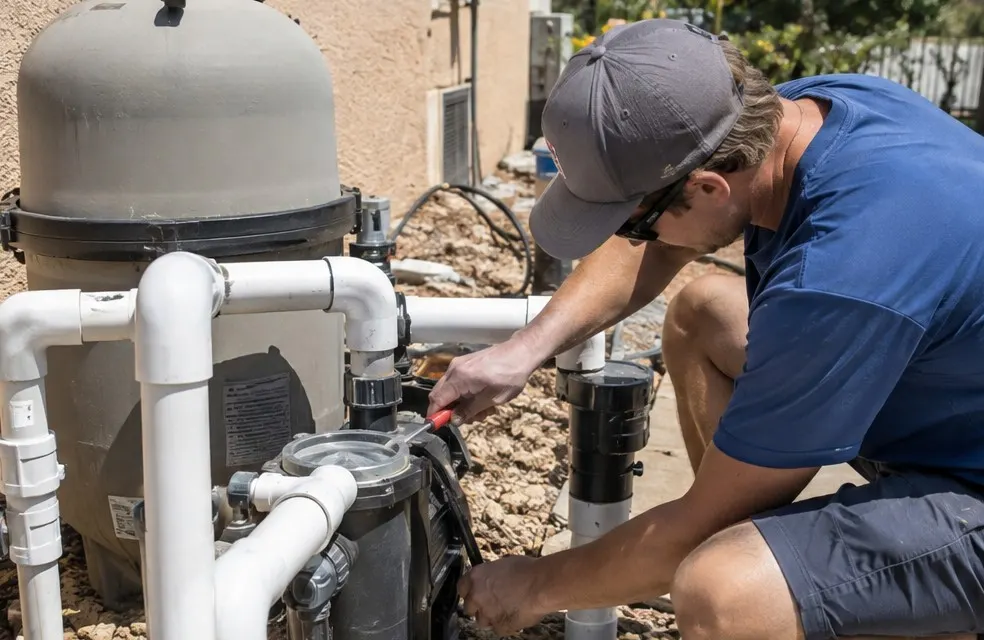
California. The Contractors State License Board describes the D-35 classification this way: a pool and spa maintenance contractor installs, replaces or repairs pool motors, pumps, filters, gas heaters and above ground piping connected to pools. Call the board before your first equipment job.
Arizona. The state's rule for the residential R-6 Swimming Pool Service and Repair classification allows a licensee to service and perform minor repair of residential pools and accessories. It excludes plumbing connections to a potable water system, gas lines, gas chlorine systems, and electrical work beyond the first disconnect. That shows how a state can split repair work into pieces, and why a pump swap and a wiring job can sit on different sides of a line.
The other states differ again. Ask your state contractor licensing board in writing which of these you may do without a license: change a pump basket lid, replace a pump motor, replace a heater, replace a salt cell, run electrical wire. Keep the answer with the date. Also tell your insurance agent which repairs you plan to sell. Nothing here is legal advice.
How do you set a repair labor rate?
Use the same cost per hour as your visits, then add the time you cannot bill. In the example, one working hour of you and the truck costs $41.60 ($6,310 divided by 151.7 hours). On a repair, not every minute is billable: you order, pick up the part, call the customer. Suppose 15 minutes of that go with each billable hour:
| Step | Arithmetic | Result |
|---|---|---|
| Cost of one billable hour | $41.60 x (75 minutes worked / 60 billable) | $52.00 |
| Price at a 25% margin | $52.00 / 0.75 | $69.33, round to $70 an hour |
The 15 minutes and the 25 percent are assumptions. Time your last ten repairs and use that. The result is what you charge per billable hour, with a one-hour minimum if your typical repair takes that long.
A trip to a pool on a day you are not there costs more. The cost of driving out and back is your drive minutes x $0.693. For a pool 20 minutes away each way, that is 40 x $0.693 = $27.72. On the customer's service day the trip is already paid for by the visit, so charge the trip fee only on other days.
For a sense of what the market pays workers in a nearby trade, the Bureau of Labor Statistics says that the median annual wage for general maintenance and repair workers was $49,590 in May 2025. That is a wage for an employee, not a billing rate, and it does not cover the truck, the insurance or the unbilled time. Use it only to check that your own pay line is not far out.
How do you price the part?
Price the part from the invoice you paid, then add a markup that pays for ordering, pickup and the warranty claims you handle. Ask your supplier for the price list and never copy a price from a website you cannot buy from. Example: a pump motor costs you $350. Marked up 25 percent, it is $437.50. One and a half hours of labor at $70 is $105. The customer pays $542.50.
Do the same arithmetic for each common repair so you know the price before you stand in the backyard. The markup is a choice. Say it on the invoice as parts and labor on separate lines, so the customer can see both.
Keep the parts you use most on the truck: pump basket lids, o-rings, the cartridge sizes you see often. A repair you finish on the first visit is worth more to the customer than one that waits a week for a part, and you save a second trip.
How do you sell a repair without pushing?
The best repair sale is a fact the customer can see.
- Take a photo or a short video of the problem.
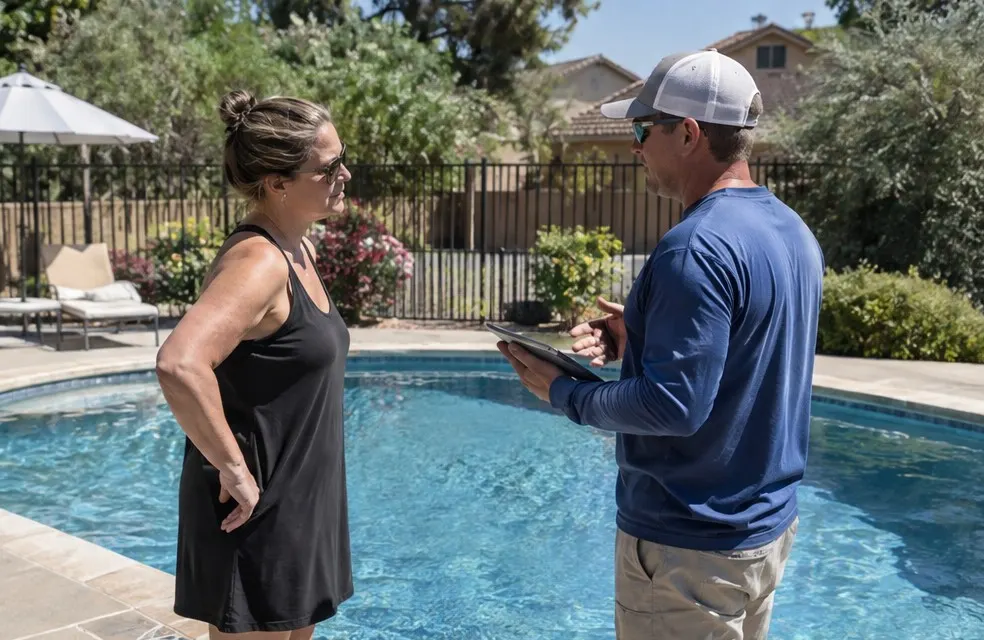
- Text it with one sentence and a price: "The motor on your pump is noisy and has started to run hot. Replacing it is $540 installed. I can do it on your next service day."
- Let them say yes or no. Do not argue.
Customers trust the tech who comes every week far more than a stranger with a van. A bad upsell can lose an account worth $2,100 a year. Never recommend a repair you would not make on your own pool.
If the customer says yes in person at their home, read the FTC page on the Cooling-Off Rule. It says the rule gives you three days to cancel certain sales made at your home, workplace, or dormitory, and that it also applies when you invite a salesperson to make a presentation in your home. The page lists sales made entirely online, by mail or by telephone as outside the rule. Whether your repair sale is covered depends on the facts, so ask a lawyer or your state consumer office before you rely on a verbal yes.
When does a variable speed pump pay off?
Do not promise a number. Ask the customer how many hours a day the pump runs and look at their electric bill. ENERGY STAR explains the principle on its pool pump page: reducing pump speed by one-half allows the pump to use just one-eighth as much energy. For savings it gives figures by pump type, for example that certified above-ground pool pumps use 11% less energy than standard pool pumps and can save $20 a year in energy costs. The same page lists the in-ground figures. Those are averages, and your customer's pool, hours and electric rate set the real number.
The payback is the extra cost divided by the yearly savings. Example only: if a variable speed pump costs $600 more than a single speed one and the customer's bill drops by $300 a year, the payback is 2 years. If it drops by $100, it is 6 years. Ask the customer to look at the bill, and ask their utility whether it has a rebate. We found no single national figure.
What about warranty and callbacks?
Tell the customer in writing what is covered: the manufacturer's warranty on the part, and your own warranty on your labor. Choose the length yourself and put it on the invoice. A callback inside your warranty is free, so budget for it. If one repair in twenty needs a return visit of an hour, that costs 1 / 20 x $52.00 = $2.60 a repair, which is small. Register new pumps and heaters with the manufacturer for the customer, and keep the serial number on the account.
What do repairs add to a route?
Take the 60 pool example. If 6 of the 60 pools buy a $540 repair in a year, that is $3,240 in billing on stops you already make, and the cost of the parts is inside the price. That is the example, not a forecast. Your own count of repairs sold last year, divided by the pools you serve, is the number to use.
Put repairs on your website
Homeowners search "pool pump repair near me" and "pool filter cleaning" separately. A page for each one, with your labor rate and what you do and do not repair, brings in people who are not yet customers. Be careful to say only what your license allows. The pool service website checklist covers the pages. The pool service estimate calculator in PoolRoute prices repairs from the rates you set.
Bill it the same month
Add the repair to the customer's monthly invoice or send it the same day, with a way to pay by card. A repair billed six weeks later is a repair you argue about. Read how to bill pool customers every month.
Frequently asked questions
How much should I charge per hour for pool repairs?
Start from your cost per billable hour, including the time you cannot bill, then add your margin. In the example it costs $52.00 a billable hour and is priced at $70 with a 25 percent margin.
Do I need a license to replace a pool pump?
It depends on your state. In Florida a license is not required for cleaning that does not affect the pool's structure, while repairing or replacing equipment falls under the servicing contractor license. California and Arizona draw other lines. Ask your state board.